From Ouroboros to the Hero: Toward a Model of Mind
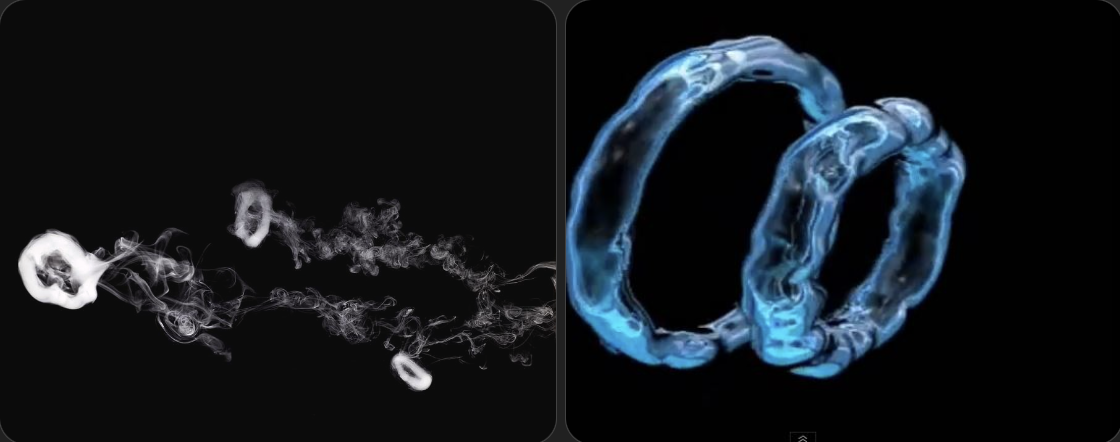
I have come to think that one of the oldest images of mind is not the mirror, nor the machine, but the loop.
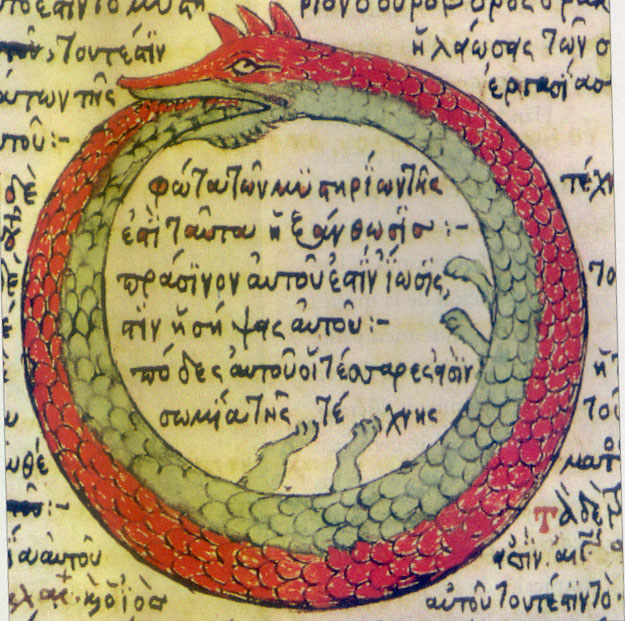
Before there is argument, before there is planning, before there is a self that stands apart from the world and names it, there is a more primitive condition: a closed movement, a circulation, something that feeds back into itself. Myth knew this long before theory did. It gave this condition the form of the serpent eating its own tail. The Ouroboros is not merely an ornament of esoteric tradition. It is an image of closure. It says: here is a being that contains its own beginning and end.
This is why the symbol persists. It names a structure more than a doctrine. It points to a state in which distinction has not yet hardened: inner and outer, subject and object, prediction and correction, self and world. Everything is still folded together.
Many modern readers are uneasy with myth, and not without reason. Myth has often been used badly: as decoration, as vague profundity, or as a refuge from proof. I do not want to use it in any of these ways. I am not treating myth as evidence. I am treating it as a compressed record of recurring mental forms. Myth does not prove. It preserves. It preserves patterns that later thought may render in other languages: in philosophy, in psychology, and perhaps, in time, in engineering.
The first of these patterns is closure.
A closed thing is not yet an intelligent thing. But no stable intelligence can exist without some form of closure. A system that does not return upon itself cannot regulate itself. It can move, but not correct. It can react, but not gather its reactions into a form. It can expand without limit, yet it cannot know when it has drifted.
In this sense, the Ouroboros is not the image of full consciousness. It is the image of pre-differentiated wholeness. It is the mind before distance. Before the world is faced as world, it is still enclosed within a kind of original continuity.
The second great image is therefore not the serpent, but the hero.
The hero appears when unity breaks. The world is no longer continuous with the self. There is distance now, and with distance come danger, error, judgment, and return. The hero leaves the enclosed circle, enters uncertainty, confronts what resists him, and comes back altered. If the Ouroboros is closure without distance, the hero is distance that learns how to return.
That, to me, is already a more precise image of mind.
A mind worthy of the name is not one that merely remains whole. Stones remain whole. Closed systems remain closed. A mind is something that can depart from itself and still recover form. It can predict and be wrong. It can act and be corrected. It can encounter surprise without dissolving. It can return, not to the same place, but to a new equilibrium.
This language may sound literary, but the structure is exact. If we strip the story of its names and costumes, we are left with a sequence: immersion, separation, trial, integration. Myth narrates it. Developmental psychology redescribes it. Cognitive theory abstracts it. Engineering, if it is ambitious enough, may eventually implement it.
This is where Jung remains useful, though only if read with discipline. His great strength was not that he proved the truth of symbols in any final scientific sense. It was that he understood that psychic life is structured, recurrent, and not exhausted by conscious self-description. He saw that the mind does not invent its forms from nothing. It inherits patterns of orientation. Some of these patterns appear in dreams, some in rituals, some in stories, and some in ordinary styles of attention.
I read the later MBTI tradition in this restrained way. Not as a final taxonomy of persons, and certainly not as a complete science, but as a rough and suggestive language for recurrent modes of orientation. Its value, if it has one, lies not in personality branding but in functional distinction. It names differences in how attention is taken in, shaped, tested, enacted, valued, and coordinated.
That distinction matters.
For a long time, discussion of these functions remained trapped at the level of description. People asked what kind of person uses intuition or sensation, feeling or thinking, introversion or extraversion. I am interested in a different question: what if these are not first of all traits, but recurrent roles in a process? What if they can be read not only as features of temperament, but as positions in a loop?
Then the language changes.
Sensation is no longer a type of person. It becomes the taking in of the present. Intuition becomes compression: the gathering of many particulars into a latent pattern. Thinking becomes consistency testing: does the pattern hold, or has it broken against the world? Extraverted action becomes intervention: the point at which a system leaves itself and commits to an external effect. Feeling becomes valuation: not sentiment, but a criterion of acceptance and refusal. And beyond the solitary agent there is another demand, often neglected in individual psychology but unavoidable in collective life: synchronization with other minds, other models, other centers of action.
One can name these functions in Jungian language if one likes. One can also discard the names and keep the roles. Either way, something important comes into view. Mind is not a single act. It is a circulation among distinguishable acts.
It is here that myth and physics begin, faintly, to touch.
The closed loop is not only a symbolic form. It is also a physical one. Rings, vortices, toroidal flows, self-reinforcing circulation: these appear whenever persistence must be won not by stillness but by organized return. A vortex does not endure by freezing. It endures by folding motion back into itself. A ring of light, if it could stabilize, would not do so by ceasing to move, but by moving in such a way that escape is no longer simple. Form, in such cases, is not the opposite of motion. Form is motion that has found a way to hold.
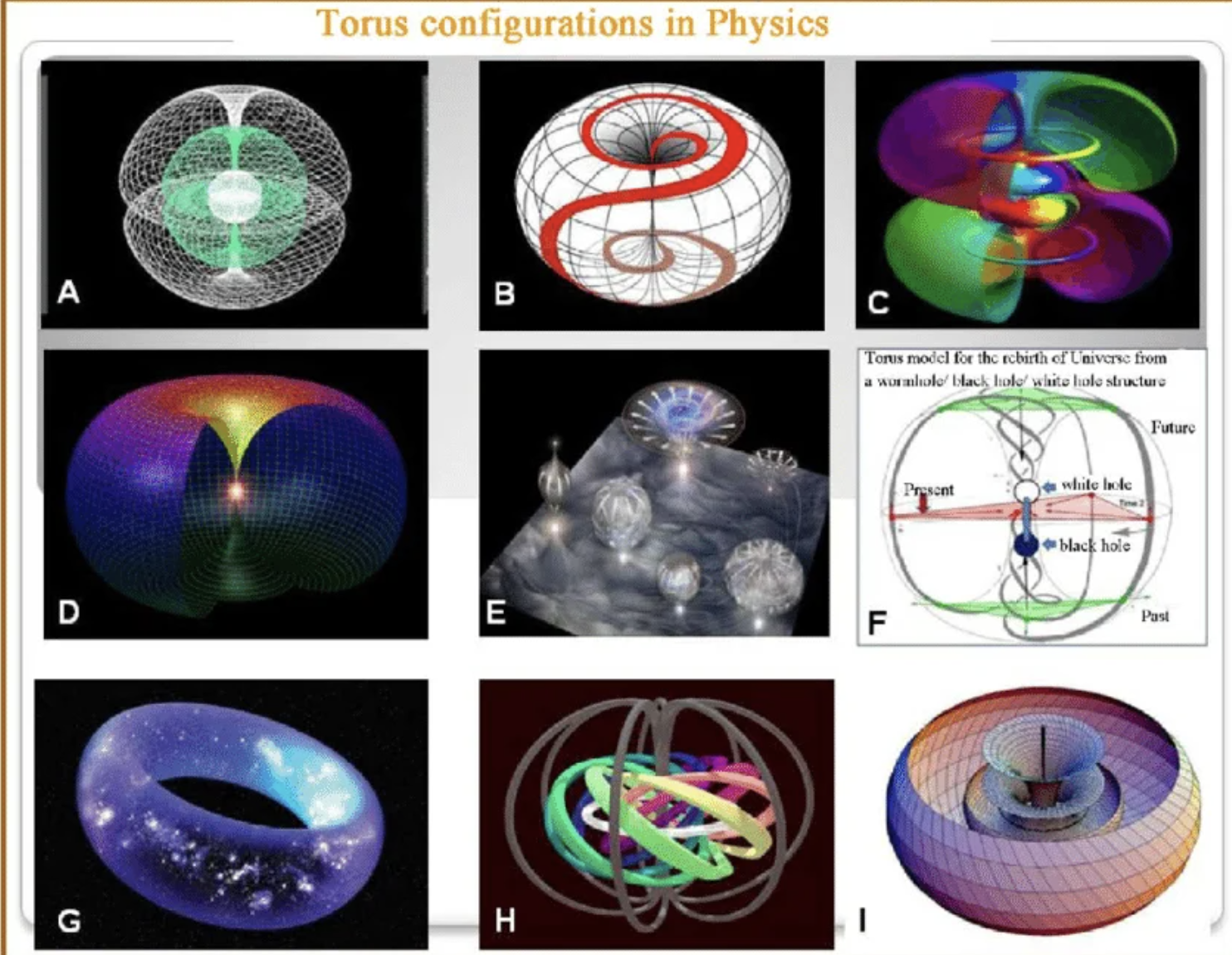
This matters because modern thought often makes a poor choice between two false images. On one side there is rigid substance: a thing remains itself because it is inert. On the other side there is pure flux: everything changes, therefore nothing can hold. But many of the most interesting structures in nature belong to neither side. They are neither static nor formless. They persist by organized circulation. Their identity lies in pattern, not in immobility.
The same may be true of mind.
A self is not a block. It is not even, in the first instance, a narrative. It is a regulated recurrence. It holds because certain processes return in an ordered way: perception returning to model, model returning to test, test returning to action, action returning to consequence, consequence returning to valuation, and valuation returning to the shared field in which more than one agent must live.
This, I think, is the point at which ancient imagery becomes newly useful. The Ouroboros names the primitive fact of closure. The hero names the necessity of departure and return. Between them lies a minimal model of mind: not a substance, not a mystical essence, but a loop that can survive error.
This also clarifies a common confusion. Self-consistency is not enough. A closed system can be deluded. A mind can become internally elegant while drifting ever farther from reality. Myth knew this too, though again it said so in story before theory. The enclosed world becomes sterile unless it is broken open by encounter. The hero must leave the circle because the circle alone cannot correct itself.
So the real problem is subtler than closure. A good mind must close, but it must also reopen. It must compress, but not collapse. It must preserve form, but not at the price of reality. The deepest tension is not between reason and myth, nor between intuition and logic. It is between self-maintenance and world-contact.
If I follow this line far enough, it leads away from interpretation and toward construction. That is where this series will eventually go. I am interested not only in what myth reveals about the shape of mind, but in whether some of these old distinctions can be recast as functional modules inside an artificial system. Not because myth proves such an architecture, and not because psychology can be copied directly into code. Rather because recurring symbolic distinctions may hint at recurrent computational problems.
How does a system take in the world without being flooded by it?
How does it compress experience without losing the difference between signal and fantasy?
How does it test its own inner coherence?
How does it act without overcommitting to a bad model?
How does it refuse what is efficient but wrong?
How does it remain itself while coordinating with others?
These are not mystical questions. They are design questions.
That is why I begin here, with myth. Not to end in myth, but to recover a language broad enough to notice the full shape of the problem before narrowing it into implementation. Much current discourse on intelligence begins too late, with performance alone. It asks how to optimize behavior before asking what kind of structure makes behavior recoverable. It celebrates generation, but speaks less clearly about return.
Yet return may be the central thing.
An intelligence that cannot return from error is not robust.
An intelligence that cannot return from abstraction is not grounded.
An intelligence that cannot return from solitude cannot enter a common world.
An intelligence that cannot return from its own self-consistency is not wise, only trapped.
The old myths placed this truth in figures. First the serpent, then the hero. First enclosure, then ordeal. First continuity, then rupture, then a higher form of coherence won through encounter.
I do not take these figures literally. But I do take them seriously.
They suggest that mind is neither mere reaction nor mere contemplation. It is a disciplined passage through closure, separation, and return. If that is right, then the task before us is not simply to build systems that produce more. It is to build systems that can come back: back from error, back from drift, back from private coherence into shared reality.
That, at least, is the path I want to trace.
This essay is only the threshold. In the next pieces, I will move from these mythic forms toward a more explicit structural language: from loop to operator, from symbol to interface, from interpretation to experiment.